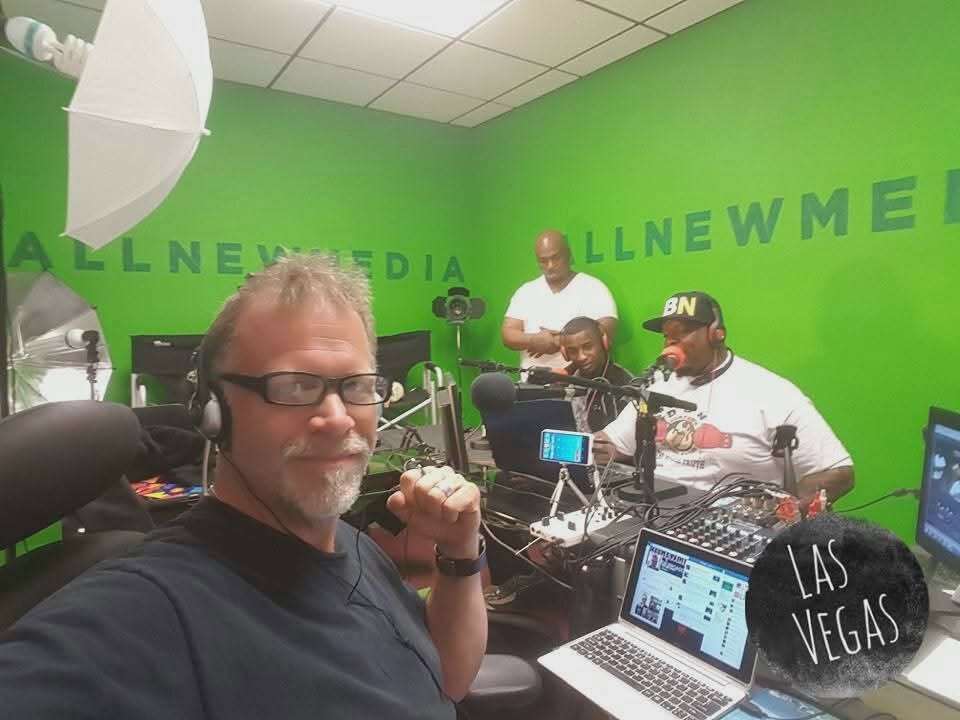
Time has beaten the hell out of a Hall of Famer, and time, apparently, has Olympic-level cardio endurance. He wears the accumulated mileage of a man who did not so much travel through life as repeatedly crash into it, unbuckled, at highway speed. He gets up slowly. One hand finds something solid. His legs raise objections. His back begins picketing on the front lines. Then he speaks.
His voice hits like gravel being launched from a slingshot directly into your eardrum. Cancer and cigarettes contributed, along with decades of using a broadcaster's voice as though it came with a lifetime warranty. Every sentence emerges smoky and rocky, as if Mount Rushmore suddenly cleared its throat.
Pushing 60, George James Carson, known professionally as GeeJay, sits with me at lunch as we do our best to recall faded memories. There was a time when color still lived in GeeJay's beard. My heart and mind drift back to the younger man.
And somewhere in that younger man's mind was the idea, going off like microwave popcorn in his brain, that radio shouldn't really need a radio. It was a completely ridiculous idea. It was also, inconveniently, correct.
He’s at the radio desk, one late night, working the console, the phones and computers like a coked-up octopus, seemingly blending into the scratches and gouges in the table. His arms flail rhythmically and wildly while he calmly adds his two cents to the on-air dissertation about nothing in particular.
Carson and I became business partners on one of those late nights in the studio, on a cold, cloudy night when even the man in the moon wanted to be left alone. Together, we pioneered AllTalkRadio.net in the early 2000s, mad scientists mixing radio, internet broadcasting and on-demand audio years before streaming and podcasting became ubiquitous in daily life. Long before Spotify, when Joe Rogan actually had hair, and even before the eventual appearance of the iPod.
“We were building the future of radio,” Carson, co-founder of AllTalkRadio.net, said. “A way for everyone to communicate across the planet.”
The internet of those days was a wild frontier of beige computers, annoyed lights, curly telephone cords and homemade websites designed by people with personal grudges against eyesight. Connecting online began with a modem shrieking like two robots in a cage match fighting over the last can of oil.
We were told it was a fad.
George “GeeJay” Carson
“We were told it was a fad,” Carson said. “There's no way internet was going to stay … and that we weren't ‘real’ radio.”
Contemporary accounts suggest the experiment became something considerably more substantial. A 2005 PR.com release identified Carson and Millian Quinteros as owners of All Talk Radio Network and described the Las Vegas operation as broadcasting worldwide, live and through archived audio 24/7.
A year later, Las Vegas Weekly framed the emerging technology as a battle between terrestrial and internet radio. An AllTalkRadio.net advertisement declared, “AM Radio. R.I.P. 1895-2005.” The publication reported that Carson's network was already distributing programming through cellphones, PDAs and other internet-connected devices.
Keith Bowen, a former AllTalkRadio host and field reporter and founder of Big Keith's House, remembers wanting in.
“This thing is going to be the next biggest thing in the world,” Bowen said. “I got to be part of this.”
Bowen also remembers the people behind it.
“These guys were hungry and they wanted to change the world,” Bowen said.
Lisa Loopole, a former radio station general manager for Gore Broadcasting, remembers the traditional broadcasting side watching Carson and the emerging network with considerably more concern.
“We were definitely worried that they were going to be what started the downfall of terrestrial radio,” Loopole said.
“As soon as these two met here, something major shifted,” Loopole said. “We knew they would do something incredible.”
Years passed. The calendar mocked us. The internet got faster. Computers stopped being beige. Phones showed up and became computers. Streaming became just ordinary. Podcasting became an industry large enough to support celebrities, corporations, entire networks and approximately 14 million men explaining why their brand of hot sauce is superior. The future had arrived.
GeeJay had already been there for years.
The strange part was that the future did not seem to remember passing him on the information superhighway.
“They used our shit and never gave us any recognition for it. We built the infrastructure and we were the pioneers!” Carson vents between slow, labored sips of chocolate milk back at the cafe.
“They turned out to be right,” Loopole said.

Carson said it took 23 years for him to finally recognize that the technology and the world had ultimately caught up with what he had envisioned. Recognition finally landed in his lap, the exact same way that a Las Vegas Showgirl doesn’t. The Nevada Broadcasters Association lists George James Carson II among its 2017 Hall of Fame inductees.
“Total vindication that we were real radio,” Carson said, “which everybody told us we weren't.”
But the future became something else for Carson. Strokes and chronic conditions cut into the ambitions and aspirations of the man who had spent so much of his life looking forward.
His piercing blue eyes tell a story deeper than his words ever could. His hunched posture screams rebellion and simultaneously whispers defeat. His voice intermittently rises in force and fullness when he makes his point, emphasizing his belief that we are owed something for our trouble. Cancer and chaos have left a jagged shell where a vibrant man used to be, but there is still enough fight inside him to sustain the cause. I’ve seen him in all forms. I remember him as he was, is and always will be.
For Carson, being remembered as an innovator matters because history needs a connection between the people who built something and the world that eventually inherited it, even if full recognition, riches and fame never followed.
We changed the world, we shaped the future, we did it.
George “GeeJay” Carson
“We changed the world, we shaped the future, we did it,” Carson said. “We literally did. In a way they said could never be done.”
They said internet and online radio were nothing but a fad with no future.
The future did eventually show up, and it brought receipts with it.
It just forgot whose name was originally on the deed.